
Required Subscription: Mitel MiVC
Required Permission Level: Reports and Dashboard Creator
A common misconception when reporting on the Dialed Number field for inbound calls (also referred to as the DID/DNIS field) is that it represents the actual number a caller dialed from their phone. Understanding how DNIS mapping works in Mitel (ShoreTel) clarifies why this isn't necessarily true.
How DNIS mapping works
There are three components to a DNIS mapping in Mitel (ShoreTel):
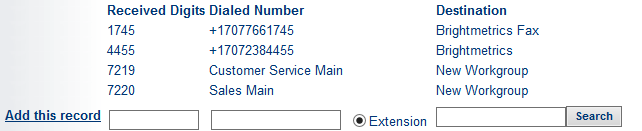
Received Digits are the digits received from the Central Office (CO). Dialed Number is what those received digits are mapped to represent. Destination is where the call is routed.
How many digits are received from the CO is determined by the trunk group configuration. In some cases the CO sends only 4 digits; in others it may send 10 or 11, in which case the received digits may actually correspond to the number the caller dialed — though this is implementation-specific and subject to CO translations such as toll-free number mappings.
What gets logged to CDR
What gets logged to the CDR database is not the received digits, but rather the Dialed Number. The Dialed Number is a free-form text field — a Mitel administrator can enter whatever they want to be logged when those digits are received. Common uses include:
- The actual number a caller would have dialed
- A logical name for the dialed number
- A toll-free number mapped by the provider to a local number, entered so the toll-free number can be easily identified in reports
There is no constraint on the format. +1 (707) 766-1745, 7077661745, and 707-766-1745 are all equally valid — Mitel (ShoreTel) logs whatever is in that field verbatim to CDR.
DIDs are a special case where the format is constrained by the Mitel system. You define a base number that received digits should complete, and Mitel logs the Dialed Number in a canonical format based on that number. DNIS mappings, however, are completely free-form and arbitrary.
Questions or feedback? Please email us at support@brightmetrics.com.